Fill out the form below to download the case study.

By using this website, you agree to the storing of cookies on your device. These cookies are used to collect information about how you interact with our website and allow us to remember you. We use this information in order to improve and customize your browsing experience and for analytics and metrics about our visitors both on this website and other media. To find out more about the cookies we use, see our Cookie Policy.
flow cytometry enumeration controls, slingshot biosciences, slingshot case
CAR-T cell enumeration is a critical process in the evaluation of CAR-T therapies, as it ensures accurate measurement of therapeutic cells in patients. This process involves quantifying the CAR-T cells in blood samples, which is essential for monitoring treatment efficacy and patient outcomes.
Accurate enumeration of CAR-T cells can significantly impact clinical decisions and patient management. By utilizing advanced flow cytometry techniques alongside innovative cell mimics, researchers and clinicians can achieve more reliable results, leading to improved patient care and optimized treatment protocols.
Cell mimics are engineered cellular structures designed to simulate the properties of actual cells, providing a reliable standard for flow cytometry assays. These mimics enhance assay precision by serving as controls that can be used to calibrate instruments and validate results.
For instance, the EGFR+ CD3+ cell mimics developed by Slingshot Biosciences are specifically tailored to improve the accuracy of CAR-T cell enumeration. By incorporating these mimics into flow cytometry workflows, laboratories can ensure consistent and reproducible measurements, ultimately leading to better diagnostic outcomes.
The introduction of novel cell mimics in CAR-T cell enumeration offers several advantages over traditional methods. These benefits include increased assay sensitivity, reduced variability, and enhanced accuracy, which are crucial for the success of CAR-T therapies.
Moreover, using cell mimics allows for the standardization of assays across different laboratories, facilitating collaborative research and clinical trials. This standardization is vital for the advancement of CAR-T therapies and ensures that all stakeholders can rely on the data generated from these assays.
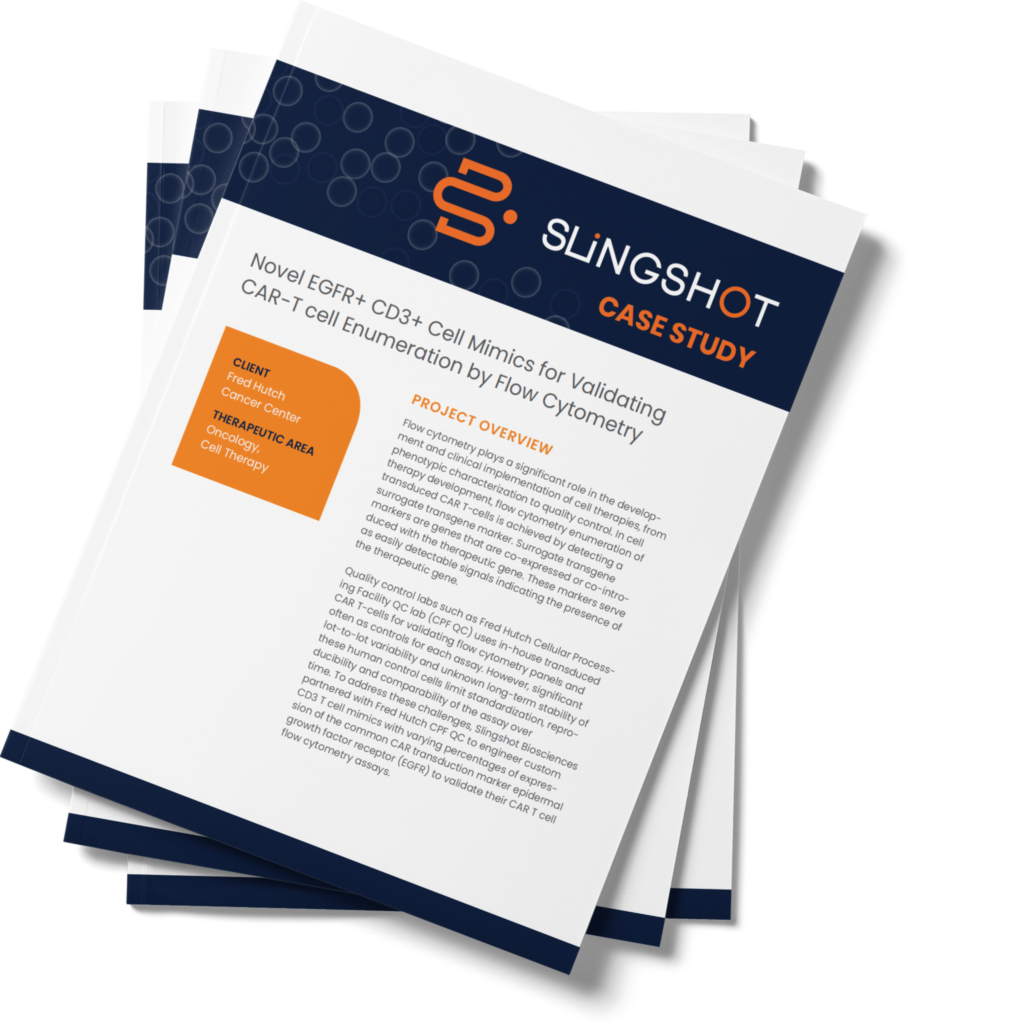
The case study on EGFR+ CD3+ cell mimics illustrates their practical application in validating CAR-T cell enumeration. This comprehensive analysis provides insights into how these mimics can be utilized to enhance the accuracy and reliability of flow cytometry assays.
Through detailed experimentation and data analysis, the case study demonstrates the effectiveness of these cell mimics in real-world scenarios, showcasing their potential to revolutionize CAR-T therapy monitoring and improve patient outcomes in clinical settings.
flow cytometry enumeration controls, slingshot biosciences, slingshot case
CAR-T cell enumeration is a critical process in the evaluation of CAR-T therapies, as it ensures accurate measurement of therapeutic cells in patients. This process involves quantifying the CAR-T cells in blood samples, which is essential for monitoring treatment efficacy and patient outcomes.
Accurate enumeration of CAR-T cells can significantly impact clinical decisions and patient management. By utilizing advanced flow cytometry techniques alongside innovative cell mimics, researchers and clinicians can achieve more reliable results, leading to improved patient care and optimized treatment protocols.
Cell mimics are engineered cellular structures designed to simulate the properties of actual cells, providing a reliable standard for flow cytometry assays. These mimics enhance assay precision by serving as controls that can be used to calibrate instruments and validate results.
For instance, the EGFR+ CD3+ cell mimics developed by Slingshot Biosciences are specifically tailored to improve the accuracy of CAR-T cell enumeration. By incorporating these mimics into flow cytometry workflows, laboratories can ensure consistent and reproducible measurements, ultimately leading to better diagnostic outcomes.
The introduction of novel cell mimics in CAR-T cell enumeration offers several advantages over traditional methods. These benefits include increased assay sensitivity, reduced variability, and enhanced accuracy, which are crucial for the success of CAR-T therapies.
Moreover, using cell mimics allows for the standardization of assays across different laboratories, facilitating collaborative research and clinical trials. This standardization is vital for the advancement of CAR-T therapies and ensures that all stakeholders can rely on the data generated from these assays.
The case study on EGFR+ CD3+ cell mimics illustrates their practical application in validating CAR-T cell enumeration. This comprehensive analysis provides insights into how these mimics can be utilized to enhance the accuracy and reliability of flow cytometry assays.
Through detailed experimentation and data analysis, the case study demonstrates the effectiveness of these cell mimics in real-world scenarios, showcasing their potential to revolutionize CAR-T therapy monitoring and improve patient outcomes in clinical settings.
